Showing posts with label 1981. Show all posts

January 3 (1981, 1989, 2000, 2001, 2003, 2008)
Big Valley Bluff ~ More on the “Blasted Trail”

January 3, 2021

Several holes, dug through the duff by one of the resident critters... was it fungi or insects it was after? Is this why I am not finding mushrooms in this area? Yep, probably.


1/3/81   Way before dawn... went to the Bluff* yesterday and hiked down to the edge of the canyon. McClungs, anxious about heights, stayed above. I got hungry for quartz crystals and climbed down the cliff in search of quartz veins; I found many veins but few crystals. Clouds came in while we were there. We left after an hour or so.

It sprinkled lightly last night, the first precipitation in weeks. Incredible weather most of December—sunny, over 70° in the day, above 40° at night.”

[Russell Towle's journal]


*The "Bluff" is Big Valley Bluff, a point on the north rim of the North Fork canyon west of Snow Mountain. It is quite unusual to have been able to visit that spot on January 2nd, since the access road would normally be long blocked with snow by this mid-winter date, being over 6000' elevation. The warm, sunny December he describes in the second paragraph explains how it could be.

View to the east from the Bluff
(Click to enlarge)

View to the west from the Bluff
(Click to enlarge)

View south across to Tadpole Canyon
Straight down over "Falcon Perch" high above the river
Taken August 2, 2008, after the "American Fire" finally died out, from the Iowa Hill Ditch trail near the head of Tadpole Canyon, looking north across the North Fork to Big Valley Bluffthe highest point on the right.
(Click to enlarge)


January the 3rd, 1989

[...]

I cried while skiing up the meadow and out from my cabin today. It really seemed like good-bye. The water line is frozen, pipes are broken inside the bathroom wall, it is all a mess and a clutter and a thousand memories of so many many prayers for someone to share that incredible beauty with. So many unanswered prayers. And there comes a point when it is just too much, it has gone entirely too far, and yet the sun lights it all up as always and I cry to think of so much loneliness. It is so less than fair. Then for my father to move out there. It's over. I'm gone; if I am seen around here now, it is only my ghost. I'm out of here.

Or so I say.

The sun sets, after another clear day, so blessed after too many storms.

[...]

[Russell Towle's journal]


Date: Fri, 3 Jan 2003 08:39:41-0800
To: North_Fork_Trails
From: Russell Towle
Subject: Blasted Trail? Uhhh ... No!!!!

Hi all,

Terry Davis of the Sierra Club wrote, of Supervisor Rex Bloomfield's proposed Capitol-to-Capitol Trail,
"Bill & Russell & others, I've been horrified by Rex's trail concept ever since he started talking about it a couple of years ago. Wide, even grade, close to the river. He refused to even talk about using existing trails. He seemed to have in mind a mini super-highway, off limits only to motorized vehicles. I think that the Sierra Club, PARC, CNPS, Audubon all need to make it clear that we will not support the trail he has in mind—can you imagine blasting through the Giant Gap and the Royal Gorge? I wouldn't be so sure it's an impossible dream. Once the EIS/EIR is approved by the agencies, the grants will just roll in. We need to strategize on stopping, or modifying, this atrocity. I hate to wait until the environmental docs are out. We need to make this controversial now. Terry"
Now, others on this list have made some inquiries, and been assured by people involved in the actual planning of the trail, that:

1. It will not go through the Royal Gorge.
2. Its actual course has yet to be determined.

Hmmm. Then why did the map in the Bee article show it going right up the river?

I agree with Terry, we need to figure out how to stop this trail.

One thing we can do right now is let District Five Supervisor Rex Bloomfield know we are opposed. Perhaps the simplest message would be, "no new trail in the North Fork American canyon." That is least open to misinterpretation. His email address is:

Rex Bloomfield [no longer relevant]

He gets all these "North Fork Trails" email list messages anyway.

Cheers,

Russell Towle


Date: Fri, 3 Jan 2003 11:20:12 -0800
To: Deane_Swickard
From: Russell Towle
Subject: Re: Blasted Trail? Uhhh ... No!!!!
Cc: North_Fork_Trails


Hi Deane (Deane Swickard, Area Manager, Folsom Area, BLM),

Thanks for your reply, in which you wrote,
>
>Relax, there is no way a trail is going to be blasted up the North Fork
>American.
>
> First, it will never pass muster on environmental grounds.  It's
>inconsistent with wild river management.  There will be no blasting a trail
>along BLM or Forest Service land in the wild river corridor.  Since most of
>the river is publically owned from 1000ft above the Iowa Hill Bridge
>eastward, a trail within a quarter mile of the river doesn't have a prayer.
Yes, this seems only what good sense would imply.
>Rex has good intentions.  Trails are very popular and there is need for new
>trails throughout the state.  In this case, he seems limited a bit by his
>knowledge of the geography, the protections afforded wild rivers and the
>difficulty and cost of trail building in steep terrain.
Yes, Rex has good intentions. But the Road to Hell should by no means proceed up the North Fork of the American River!

Although it seems to me that no new trail would be allowed to be constructed within the North Fork American Wild & Scenic River corridor, nor, for that matter, within the canyon at large, this idea has been kicking around for a few years now, has not gone away, and in fact, has attracted a grant of $1.5 million from the CA Resources Agency, and a grant of $400,000 from the Placer Legacy.

It could be that Tahoe National Forest District Ranger Rich Johnson, of the Foresthill Ranger District, has provided encouragement to Rex Bloomfield, about the prospects for building a new trail, suitable for horses and mountain bikes, up the river, within Tahoe National Forest. For, Rich Johnson has said to me personally that he envisions opening up a trail from Mumford Bar, downstream to Italian Bar. Such a trail, I believe, existed in the 19th century, since I seem to recall that, in his diary, I.T. Coffin records going from Italian Bar up to Mumford Bar in 1863, along the river, which would be quite a strenuous exercise without some kind of trail to follow.

So, in this one reach of the river, it could be maintained that a trail already exists.

Similarly for the reach from Euchre Bar, upstream to Italian Bar.

I have been scouting out some of these old trails, now abandoned, but hesitate to bring them to the attention of Tahoe National Forest, lest they become mountain bike trails. I have about had it with mountain bikes in the North Fork American, especially within the Wild & Scenic River corridor.

Thanks again for your remarks, which tend to quiet my extreme terror.

All the best,

Russell Towle


January 2 (1977, 1981, 1984, 1985, 1987, 2006, 2007)
Miscellany

1/2/77   well. a rainy day here in the sierra, clouds right here upon us, winds, a real storm. the Big Window is in, lynn and steve and steve helped me.

seeing the big window in has inspired me, i would like to have the time and money to finish it right away, the cabin i mean. but i don't. should go down to año nuevo soon—pescadero rather—and get back to work.”

Russell Towle's journal


1/2/81   Before dawn. Waning crescent moon hangs low in the east. Venus not up yet.

[...]

Today I'm going to take Charles and Charlotte and Jim and Mindy up to Big Valley Bluff.”

Russell Towle's journal


1/2/84   Life is rich, and I am left-handed. Not rich myself, there is only one 12-volt light in this small cabin. So I am askew, trying to keep the shadow of my left hand at bay while I write. A cunning paradigm of my psychic stance these days? At any rate, the morbid depression (shadow of the left-hand, sinister somber) I used to dread in the winter has been kept at bay by Lovers Leap.”

Russell Towle's journal


January 2, 1985

Morning, foggy and cool. Yesterday I went into Alta for breakfast and found Charles and. Char engaged in the same; later I joined them at their house and got involved in grading out the basement driveway with Charlie. Then we proceeded to get his truck stuck and spent about an hour extricating it.

From there I went to Shelley Yamamoto’s New Years party and gorged myself on sushi etc. I hung around for the rest of the day and watched a movie with Shelley and Carla. Carla is still living at the Rawhide. She is such a strange woman. An artist, a recluse, an attractive woman but never a boyfriend. Now her life is lived in much different terms. Without Jim, her father, she is faced with suddenly being on her own. The situation at Rawhide is not a good one for her; she never bothered to learn to drive until recently, and now must negotiate that horrendous jeep trail winding for miles along the rugged canyon wall. Yesterday she walked the five miles into Shelley's for the party rather than drive.”

Russell Towle's journal


1/2/87

1:55 A.M. Contrary to what I wrote above [on 1/1/ 87], I mounted the bicycle and went into Shelley's and had sushi after all and then rode to the McClungs [...]

I have been starving, and a sort of hole is in my stomach, it's as though I can never really fill it. I did eat well at Shelley's tonight. Skies have cleared; maybe go skiing tomorrow with Charlie.

Night. Skies clouded back over, and I never went skiing today. No. I rode Bill's bicycle into Bill's and drank some coffee with him, showed him Larson's letter, […]

Bill gave me a ride down to Colfax today to get the rebuild kit for my slave cylinder, and kindly brought me home and waited until I fixed it; he's really been very friendly to me lately, so nice.

A big storm is said to be on its way. I cut a little firewood today. So, car is parked out on the road today.

After fifteen minutes on the stove [referring to the typewriter], the "a" has stopped sticking. If it's a lubrication problem this could only make it worse, by further drying and outgassing of the lubricant; but for awhile, the decreased viscosity compensates…”


Date: Mon Jan 02 2006 04:58:24
To: Michael Joyce
From: Russell Towle
Subject: North Fork Dam


Have you ever visited North Fork Dam?

Take Foresthill Road across the bridge, in a mile or less you reach hard left onto Lower Lake Clementine Road, follow it until it bears hard right and down towards the boat launch.

Park as soon as you can and look into the canyon beside you. You will see the dam.

Then find use trails which lead down to the viewpoint.

It is like Niagara Falls, right here in Placer County!


Date: Mon Jan 02 2006 05:13:47
To: Dan
From: Russell Towle
Subject: Re: Sailor Meadow
Cc: Patrick Kavanaugh
>I bring this up because the County is agressively building at Dewitt and I am not sure this site is safe. Just want it to be set aside if possible  but My name is "mud" at the County. Any thoughts?        Dan
My thoughts? We are paving over Indian sites every day. I made my own efforts to get the County aware of Indian sites, in the mid-80s. I failed.

I understand that new state legislation, tho, is far more protective of arch sites than anything before. I have cc'd this to Patrick Kavanaugh, who knows a lot about these issues.

However.

Most people don't know history. The whites (Europeans) stole California from the Indians. We even admitted it in 1852 when we (Europeans) negotiated treaties with the CA Indians, called the Barbour Treaties.

Among these is that negotiated with the Maidu and Chief Weimar, who made his mark on the 1852 treaty at Storms Ranch, over by what would become Chicago Park.

These treaties would have made the theft of California legal; the Indians would trade title to most of the lands in exchange for big chunks here and there ("reservations"). The Maidu reservation would have been huge, from the Bear to the South Yuba, from the Valley to Storms Ranch. Roughly.

But the U.S. Senate put the Barbour Treaties in a sealed secret archive not to be opened for fifty years.

So legal title was never obtained from the CA Indians. The treaties were forgotten as most of the Indians soon died from disease.

Finally, in 1938, the BIA renegotiated treaties with surviving CA Indians and they signed away title.

In theory, that was the legal instrument by which the theft of CA became legal.


Miscellany
[North Fork Trails blogpost, January 2, 2007:
http://northforktrails.blogspot.com/2007/10/miscellany.html ]
Happy new year, 2007 should be a good one!

The other day I approached my teenage son with an excellent idea: "I will first put the chainsaw in my old backpack; next, I'll put that old backpack on your broad shoulders; then, away we will go, down and down and down, into the depths of Green Valley, there to clear brush from the High Ditch."

To which he replied in a series of rather emphatic and mostly monosyllabic negatives, scarcely comprehensible, exclaimed in his curious teenage slang.

I decided not to press the issue, just then. Perhaps a negative would ripen into a maybe. A day later I recalled that the Green Valley Trail itself is getting so badly overhung by manzanita, that this business of carrying chainsaws in backpacks is maybe not an idea worthy of the brightest star in the heavens. So I rephrased my Plan: now he would carry the chainsaw a short distance, very short, really, and I would cut the gnarled deep red branches, and he would toss them off the trail.

Another series of foreign-sounding exclamations, all negative. Sigh.

So this morning I put the damn saw in the damn pack, and carried it down to the uppermost bad section all by myself. I worked over a reach of about two hundred yards and achieved something, less than I had imagined, better than nothing. The day was grey and cool and good for trail work.

Ron Gould suggests that we should round up a real work party and hit the whole trail. A good idea. The manzanita is getting worse and worse in a number of different trail reaches. Supposing we were to carry some of the dratted garbage up and out, from the end of the West Trail, down by the river, well, a frame backpack is the best tool for garbage, and the manzanita would drag and catch and claw at our packs and turn an already tiresome task into a bitter fight. So a bit of manzanita trimming is definitely in order. There are, also, one or two new trees down on the trail, which need cutting into pieces before they can be moved.

Life is more than trails and saws.

Music, music, music. Antonio Carlos Jobim! I rec'd a CD for Christmas, titled "Elis & Tom," the amazing Elis Regina singing the songs of the amazing Tom Jobim. One song especially excited my interest, Águas de Março, or Waters of March; here Jobim joins Elis in a duet. I Googled around in search of more information, for it seemed such an exceptional performance, and found a video of the actual recording session, in Los Angeles, in 1974!

What? How could that be?

It was on YouTube, of which I had heard but not seen. I naturally avoid such sites because I have such a poor internet connection, it takes forever to download content. For the Waters of March, however, forever was fine. I waited, I waited, I waited, and at last I watched.

Really really great!

So. I saw that anyone in the world can upload videos to YouTube. I quickly assembled a few short pieces of geometrical animations I had made years ago. See

https://www.youtube.com/user/rufus16180339887


 Links
Elis Regina and Tom Jobim recording Águas de Março (Waters of March) in Los Angeles in 1974: http://www.youtube.com/watch?v=jYLoxMtnUDE

About the song on Wikipedia:
http://en.wikipedia.org/wiki/Waters_of_March

Jobim's own beautiful re-write of the lyrics into English can be found about 1/3 down this page, (after the parallel version):
http://www.brazzil.com/p08sep01.htm


April 2 (1978, 1981, 1983, 2003, 2011)
Signs of Spring

4/2/78 ~ morning sun is showing for the first time in days, and fog billows extravagantly out of green valley. this morning, for the second morning in a row, there was a loud, rather sharp barking nearby, towards the green valley trail, and I suspect coyotes or foxes may have a den in the vicinity, and the pups may be the barkers.

many birds flit through the trees this morning ~ robins, jay's, flickers, acorn woodpecker, nuthatches, hummingbird…”

[Russell Towle's journal]


4/2/81 Just before dawn, the skies are clear above, clouds ring the horizon.…
We went x-c skiing Monday, to the Onion Creek area, an exhilarating day on virgin powder. Tuesday we went to Donner Ski Ranch and bought lift tickets; I practiced my telemarks all day. Slowly improve.”

[Russell Towle's journal]


4/2/83 a lovely morning ~ fog and sunlight play in the canyon, baroque music on the radio, chuckling fire in the stove.

I've been working on the tunnel, or the cave-in actually, and have made some progress, perhaps 1/20 of the material has been washed away. The water flow is subsiding, and thus not as much material can be moved.”

[Russell Towle's journal]


Date: Wed, 2 Apr 2003 13:22:06 -0800
To: North_Fork_Trails
From: Russell Towle
Subject: Meeting Date: Correction

Hi all,

Recently a dozen or so of us met to consider formation of a non-profit organization devoted to the North Fork of the American River. I mistook the date set for the next meeting. Jim Ricker and Catherine O'Riley tell me that the correct date, time etc. is

Wednesday, April 30, 7:00 p.m., Dutch Flat Community Club, Stockton Street, Dutch Flat.

At this meeting we will consider

1. What shall be the name of the corporation?
2. What is our Mission Statement?
3. What form shall the corporation take: voting, non-voting? What shall the Articles and Bylaws be?

For example, the short form of the mission statement might be something like "[Name of Organization] wishes to preserve public foot access to historic trails, and protect the wilderness and scenery of the North Fork of the American River." A longer version might mention land acquisitions, or conservation easements, or education, or influencing policy.

Other news: on Saturday, April 5th, I am leading a hike down into Green Valley, on the North Fork near Alta, for Nevada County Land Trust. Cost for non-members of NCLT is $15. We will meet at the bottom of Casa Loma Road right off the Alta exit from eastbound I-80 at 9:00 a.m. This will be a strenuous hike which may involve rain or snow.

Cheers,

Russell Towle


April 2, 2011
The snow has melted off the Hound's Tongue shoots as of April 1, and they're even harder now to notice, the colors have dulled. They don't seem to have grown in the two weeks since I first noticed and photographed them. 

Refer to the  March 31 post 
 Hound's Tongue shoots amid Kellog's Black Oak leaves.
This has been an extraordinarily rapid snow melt! Just one week ago there was 4 feet of snow on this very spot!

~ Gay, 2 April 2011


March 30 (1981, 1982, 1988, 2001, 2006)
Superman Point

3/30/81 clear skies and fresh powder up above. There I will soon be, on my skis, gazing about the wilderness.…”

[Russell Towle's journal]


3/30/82   Still snowing. About 2 feet on the ground now, and still snowing. The temperature never climbed above 30° here yesterday, in outrageous blizzard conditions. I'm developing a finely tuned sense of when I must move the Toyota or face entrapment. Moved it a necessary 50 yards at dawn yesterday; after a couple of hours of very heavy snowfall, had to take it the rest of the way out (to civilization-plowed roads) or else; so I did, my front bumper spraying snow the whole way.

This storm just won't let up. Snow falls more horizontally than otherwise. I tune into the NWS, and they opine that it ‘will arrive tonight’ ~ that should be quite a show.

I've been recovering, bit by bit [respiratory ailment]. Yesterday I was energetic enough to do my laundry, do a little skiing, dig my Toyota out of the snow about 10 times (I haven't put chains on yet and it rarely occurs to me to do so)—but that was a lot. When I reached the cabin, I ate and immediately spaced out ~ slept? ~ On the couch. Awoke at midnight, to bed; tired, but not feverish.

Then, arose this morning at 4:00 AM, got into heavy shoveling of snow to reach the outhouse; then fought a frantic battle with the frozen pipes, in pre-dawn pitch darkness powered by tiny flashlight.… lost. At dawn, snapped on my skis, delighted that I had so much energy, and skied out to the cable and back. Then repacked part of the track by skiing out and back again. But by then, my right lung hurt, and I was spitting bloody phlegm. Very scary to me. I was miserable, in fact. I rolled up in Oaxaca blanket and slept from 7:30 AM to 12:00. Now the lung hardly hurts at all. No blood anymore. If it would stop snowing I would go out skiing again. Actually, it's the wind.

Pipes still frozen. Having a fire is dangerous.”

[Russell Towle's journal]


3/30/88   afternoon of a faun, wind-blown crystal seething sharply cut and cool, sun so bright, I relinquish Seneca and Naturales Questiones and curious comments about comets, leave Suetonius and the exertions of Caesar, for my own grappling skirmishes with dead ceanothus, cleaning [their] corpses from the Grassy Knoll, peeking at peaks and a withering snowpack, observing a bold bracken fern breaking ground for its brethren, spinning lax fancies with a languid brain, about this or that project, a road of boulders here, a toolshed of boulders there, a clearing of further brush, of pines, of cedars, or maybe (shiver) just leave them well enough alone, block the wind, trap the sun; enshrine a thick and tangled copse so as to say, “Ecce! Once all was this!” ”

[Russell Towle's journal]


Date: Fri, 30 Mar 2001 08:54:16 -0800
To: North_Fork_Trails
From: Russell Towle
Subject: Adventure on the North Fork
X-Attachments: River_Trails.jpg:

Hi all,

Yesterday, Canyon O'Riley and I worked a bit on the road coming in to the Canyon Creek Trail at Potato Ravine Pass. We clipped about 100 manzanita and deerbrush branches and worked up a sweat. Then it was down the trail to the river, then upstream on the old river trail. Our objective: to see if anything like this old river trail reappeared farther up, especially, near a "particular ridge" projecting into Giant Gap from Moody Ridge, about a mile and a half upstream from Canyon Creek.

A map is attached, with contours at 100-foot intervals, bold contours every 500 feet, some contours labeled, and some points labeled. The Canyon Creek Trail is a yellow line, the two previously known reaches of river trail also yellow, the new reaches explored red, dashed where uncertain. The North Fork is a broad white line. The numbers on the sides are UTM coordinates in meters.


The river is flowing pretty high and clear and cold; a lot of snowmelt, with the warm weather.

The (first part of the) old river trail is in pretty decent shape, after the brush clearing project of a couple of months ago. After 1/2 to 3/4 mile it leads down to the river with a branch staying high, which branch, however, is overgrown and hard to follow. We followed the river instead, for I had the strongest image in my mind, that we could boulder-hop all the way up to the particular ridge. How wrong can a person be? We soon found ourselves stopped cold by cliffs plunging right into the roaring torrent, and had to climb high to pass them. A couple of times we descended to the river, expecting to be able to follow it, but, no. No, no, no. It became a kind of exercise in gymnastics, but no matter how cleverly we passed this or that obstacle, soon enough, there was another cliff. Finally, after a lot of up-and-down and huffing and puffing and getting all hot and bothered, we gave up on the river and found the trace of a high trail.

It soon headed directly into a dense thicket of bay laurel, interwoven with poison oak. The poison oak, by the way, seems to be doing well everywhere in that district. For a while we were stopped and then said, more or less, damn the torpedoes, and picked our way through the glistening poison leaves, on a line about 50 feet below the trail itself.

As if rewarded for our pluck, suddenly the trail became even more well-marked, and there could be no doubt of it being "the" high river trail. It even had some rock work and some switchbacks, and finally descended to the river just shy of the particular ridge. Here we found an abandoned kayak and some other gear. Probably the person will come back. We did not see a paddle.

By using our imagination we could perceive that yes, just as we had hoped, a trail continued high along the particular ridge. Rock-hopping over to its base, Canyon went up into an ocean of poppies and lupine and found the high trail. It was the real deal. On we went, reaching a trash-strewn miners camp from a decade or so ago. Then on just a mite farther, and we were rewarded with a fine view up the gorge, the North Fork churning along between two cliffs. Here there was no obvious continuation of the high trail, although, to be fair, if it had continued, it would have had to have climbed another one or two hundred feet at the least. We did not climb up to look for it. The cliffs here had suddenly gained much in magnitude and steepness. At the point we reached, we were atop a 100-foot perpendicular cliff beside a deep pool. It could be called Superman Point, because, with complete disregard for safety, one could easily jump into the pool. Unfortunately the pool looks to be only about six or eight feet deep below the cliff.

The afternoon was waning, the shadows growing long, so we started back out. Where Canyon had climbed straight up, we found the trail actually itself climbed up by a nice switchback a little ways farther downstream, moreover, the trail continued past the switchback. In a little ways it reached a little flat campsite from the days of '49. Beyond there it was horribly overgrown, so we dropped back down to the river, and picked the trail we came in on, near the kayak.

Incidentally, these old miners' camps are usually tucked within the shelter of live oaks. It is amazing, almost unsettling, how little shelter there is from the sun down there, especially near the river. There are no alders or willows or cottonwoods at all to break the force of the sun. It is just rock on rock, cliff on cliff, a hundred thousand flowers on the slopes above, and the roaring, dancing, dangerous river. And the sun. Sun on sun.

For a long ways this trail is in remarkably good shape, though often overgrown. Then a critical region is reached where things become less certain. This is shown as a red dashed line on the map. There are some big blades of rock and one branch of the trail runs high to pass these. I mean, fully 400 feet above the river. Another branch runs low, but is faint. We took the high road and soon found ourselves blocked up severely by a big area of blooming buckbrush. This was, however, familiar to us, from our efforts of a month ago to find a continuation of the high trail. We adopted the same strategies to pass the brush, and soon enough found a certain ravine where, having crossed to the west side, we stopped at the "miners' tool cache," where we did some cleanup. I had brought a garbage bag for just this purpose, and gathered old batteries, a flashlight, all kinds of miscellaneous plastic, and four five-gallon plastic buckets. These had been in enough sun over however many years to have partially disintegrated, so we picked up all the scattered pieces and jammed the intact ones together, packed it all up and continued west. There remains a sleeping bag and some clothes and a foam mattress. And a bunch of tools, including two sluice boxes.

This was the last of the uncertain part of the high trail. It traverses a grove of canyon live oaks well above the river, then hits another ravine, where one must descend two hundred feet to reach the "main" old river trail. Soon we reached Canyon Creek.

The sun set as we came up the Canyon Creek Trail. We were moving slowly, it had been a real thrasher, an incredible workout. Apparently I am notorious for such adventures. The unwary accompany me on a hike. They imagine it like this: a broad, flat, shady trail, possibly downhill the entire way, and downhill on the way back as well. Without warning, they face a nightmare of cliffs and gorges and poison oak and rattlesnakes.

These old river trails are severely influenced by the topography. A cliff or a rock blade may force the trail up a hundred feet or more. A ravine may force it down fifty, then up fifty on the far side. The steeper the terrain, the bigger the rock blades, the higher the trail is above the river. We found ourselves 400 feet above the river at times. I would say with all the various ups and downs of our little 1-and-1/2-mile jaunt up the river from Canyon Creek, we added at least 1500 feet, maybe 2000 feet of vertical climb, to the rather mild 1500 feet from Potato Ravine Pass down to the river on the Canyon Creek Trail. So it was a 3000- to 3500-foot day.

The flowers are really spectacular. The poison oak is viciously robust. The sun is hot, the river is cold, the rocks are steep. Truly the North Fork American is a wonderful river. We got back to the Dutch Flat exit and saw that the waxing crescent moon was centered between two planets.


March 30, 2006
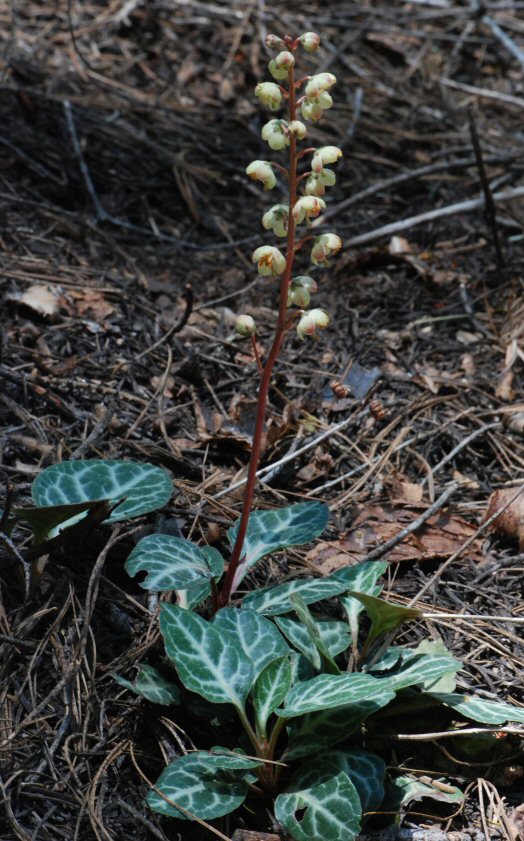
A common plant of the shady forest floor in the North Fork canyon is White-veined Wintergreen. Russ altered this photo highlighting leaf edges, and named the file "abstracted pyrola".

View a CalPhotos database image of a blooming un-abstracted White-veined Wintergreen:
http://calphotos.berkeley.edu/imgs/512x768/0000_0000/1109/1006.jpeg


March 29 (1979, 1981, 1988, 2001, 2004)
Hound's Tongue and Tufted Poppy ~ Euchre Bar footbridge

3/29/79   although the stars were visible last night, this morning a solid sheet of grey covers the sky…

i was going to take a walk, as the clouds were breaking up and i haven't been out hiking around for a while. however, thoughts about the necessity for self-reliance, and the sorry state of my volkswagen lately, had me lying down and checking my valves. what a wonderful feeling, to fix one's car all by oneself. it runs much better.

then i went on my walk. i ended up on top of moody ridge. the sun was low in the west, and its light penetrated the canyon in a long band, as often happens. however, across the canyon it was raining lightly, and there was half a rainbow springing up from a a thickly forested gully. i watched it for about 20 min. it was a beautiful sunset, bejeweled by a rainbow. the rainbow looked like a pillar of gold.”

[Russell Towle's journal]


3/29/81   Rain, with the sun trying to poke through right after. …

We went skiing yesterday. Up to Rowton and back. Discovered a nice route to the Meadows of Onion Creek's many forks, along the south side of the ridge. Telemarking is hard in deep slush.”

[Russell Towle's journal]


3/29/88    Sunset hour, on a day gradually softened by filmy clouds, the air almost tangibly thicker after several days of very dry north winds.”

[Russell Towle's journal]


March 29, 2001
  Hound's Tongue
(
Cynoglossum grande)


Note from Gay: In late winter and the mud of early spring, when flowers still seem impossible, when I feel in desperate need of color in my life as winter wanes — suddenly appear these waving flashes of blue and purple in the forest, in the first melt patches, catching and compelling my eye. And then, very soon, holes in the leaves indicate that the caterpillars have emerged, to gorge themselves for days on the big juicy leaves of their favorite host plant. They're so colorful as well!
Caterpillar of the "Police Car Moth"
(Gnophaela vermiculata)
The plant is sometimes confused with Velvety Stickseed; the flowers are quite similar, but the leafing pattern is different. Hound's Tongue leaves are large and basal. Stickseed leaves are smaller, narrow, and they grow off the stem as in this photo at the CalPhotos database:
http://calphotos.berkeley.edu/cgi/img_query?enlarge=0000+0000+0309+0342
And here is a link to a photo of the resulting Police Car Moth:
http://calphotos.berkeley.edu/imgs/512x768/0000_0000/0609/3303.jpeg

Date: Thu, 29 Mar 2001 08:22:58 -0800
To: Karen Callahan
From: Russell Towle
Subject: Re: Houndstongue caterpillar, etc.

Tufted Poppy
(Eschscholzia caespitosa)
Karen,

>adult-hood. Great pictures! I think the small poppies
>on Canyon Creek are Eschscholzia caespitosa, Tufted
>Poppy. I checked on the poppies & E.Lobbii grows at
>much lower elevation.

E. lobbi says Munz to 2000 feet; poppies photographed at Canyon Creek ca. 2400 feet.

Also, Munz has tufted poppy petals "1-2.5 cm. long" whereas Lobb's poppy petals "7-15 mm. long."

Hence Lobb's would be much smaller. You must be right, Tufted Poppy it is. Thanks!


The Footbridge at Euchre Bar
March 28, 2004


Russell Towle selfie, with the North Fork American River, at Euchre Bar footbridge, 2004


March 25 (1981, 2001, 2003, 2008)
Flower Gallery. NFARA is Launched

3/25/81 rain, rain, rain… And snow up above. Fire crackles.”

[Russell Towle's journal]


Date: Sunday, 25 March 2001
To: North_Fork_Trails
From: Russell Towle
Subject: Flowers

Hi All,

I put up some pictures of flowers in Canyon Creek, this year. More to come as more comes into bloom.

Flowers and Ferns
of Canyon Creek

Winter and Spring, 2001


~ Special thanks to Karen Callahan ~

Photography by Russell Towle


The upper trail is crowded with Rue anemone right now, and larkspur is coming on strong down by Gorge Point. Also some poppies have appeared, violets, and others.

Cheers,

Russell Towle
[The page Russell was referencing is now archived on Ron Gould's North Fork Trails website, here:
http://www.northforktrails.com/RussellTowle/NorthFork/Wildflowers/Flower_Gallery.html ]


Porch worms, after heavy rains, 3/25/2001

Date: Tuesday, 25 March 2003
To: North_Fork_Trails
From: Russell Towle
Subject: Meeting Report

Hi all,

Some of those interested in forming a non-profit organization devoted to advocacy of environmental issues in and around the North Fork American, met at the Dutch Flat Community Club on Monday evening. Thanks to some diligent telephone tag on the part of Catherine O'Riley, we expected seven people to attend, but were pleasantly surprised when fourteen people arrived.

Jim Ricker of Dutch Flat ably presided over the meeting. He astounded me by bringing along a folder containing his notes of the meeting we held in March of 2000, at Bob & Judy Suter's house, in which we discussed forming a non-profit organization. Susan Prince of Dutch Flat used an amazing little folding keyboard attached to a Palm minicomputer to take notes.

I had envisioned reading aloud the text of six emails received from people interested in forming a non-profit, but unable to attend the meeting, but the opportunity never seemed to arise. Thanks nevertheless to those who offered support and suggestions, notably Michael McCormack, Tim Lasko, Tom McDonnell, Michael Joyce, Bill Newsom, and Evan Jones. Catherine and Jim did take the time to read these emails, at any rate.

Having established that those present were all in favor of forming an organization, and moreover a non-profit organization, we moved on to the initial issues of, first, what should the name be, and second, what should the "mission statement" of the organization be. We did little more than chalk up some possibilities on the old blackboard (the DF Community Club is the old DF school, which dates to 1898).

We scheduled another meeting for early May, on Monday the 6th, I believe.

Suggestions as to a name are welcome. Since we intend to defend the wildness and beauty of the North Fork of the American river, the name should reference that. Immediately we have quite a mouthful of words and syllables. Hence a name which lends itself to a good acronym is desired; much as the group "Protect the American River Canyons" has the acronym "PARC" which of course sounds like "park."

Incidentally, from an historic viewpoint, the phrase "American River Canyon" was taken to apply only to the North Fork canyon, not to any other branch of the American river. However, this point has been muddled over the course of time, and nowadays one often finds other forks of the American denoted as *the* American River Canyon. All this is only to say that a name which includes the phrase "American River Canyon" is susceptible to misinterpretation on the one hand, and confusion with PARC on the other.

The meeting went very well. Thanks to all who attended, and all who sent emails.

Cheers,

Russell Towle


March 25, 2008

“Playhouse Oak,” Moody Ridge

[Russ discovered this tree near the pond, along the line of an old narrow gauge railroad bed, in a thickly-forested area where he was doing some clearing and burning for the property owner.]


March 16 (1976, 1981, 2006)
Midnight Flyers. The Neeshenam

3/16/76 ~ thank god for the sense of smell ~ my eyes and ears tell me that it is spring, but when i smell the air outside, i know it. yellow star tulips and buttercups are blooming in the yard. mourning dove repeats its sweet call.”

[Russell Towle's journal]


3/16/81  the last few minutes before dawn… A night of heavy rain, and the clouds swept on by; now a river of fog flows down canyon; it is smooth in Green Valley, turbulent in Giant Gap, mimicking the tiny N. Fk. far below.

Bald Eagle, circling about near Casa Loma, near here.

A yellow violet in bloom, a biscuit root, a multitude of houndstongue flowers.

It is my mother's birthday, and yesterday 'twas Neil's.

Ah, to ski, to explore, to make love, to make music.

~ It is the instant of sunrise, a clear sky above, a river of fog below. The fog seems excited, agitated, by the rising of the sun; it yearns and reaches for that warm embrace. Tongues lap the canyon walls, fog rubs up against, arches back, the river purrs. Exotic lands come into view, illuminated manuscripts of rock and oak and douglas fir.”

[Russell Towle's journal]


Birds, Storms, and the “Neeshenam”
[North Fork Trails blogpost, March 16, 2006:
http://northforktrails.blogspot.com/2006/03/birds-storms-and-neeshenam.html ]
First I wish to thank those who've sent contributions to the North Fork Trails email list. It is gratifying to find that you value my efforts.

Birds and Storms II: thunderstorms and other storms of snow have continued here at 4000', and now there is two to three or four feet of the nastiest snow-sludge imaginable. But a few days back, during a day of thunderstorms, once again I heard the lanky Sandhill Cranes, once again they circled between clouds, hundreds of them, yelping loudly, and I actually saw flocks of them fly directly into clouds, and disappear. But that's not all; at midnight, during another break in the constant snowfall, I heard the cranes again, a smallish flock of a dozen birds by the sound of it. What were they up to, dodging thunderstorms of snow in the Sierra, at midnight? Unbelievable!

And now sleet rattles my windows.

I have a bit of California history for you: Stephen Powers' 1874 Overland Monthly article, "The Neeshenams," number ten of his series on the California Indians. It was these articles which inspired John Wesley Powell (of Grand Canyon fame) to put Powers to work writing a more formal treatment, "Tribes of California" (Washington, Government Printing Office,1877).

Today we call this branch of the Maidu people the Nisenan. Everything below must be taken with a grain of salt; we might imagine Powers to have spent little enough time with the Nisenan, and he himself remarks that they were, above all other Calfornia Indians, the most severely impacted by the Gold Rush. By 1874 their culture was in tatters; they had already been forced out of Placer and Nevada counties, on a trail of tears to what was hoped to be a better life on reservations in the Coast Range; but Indian Agents waxed rich and fat, and the Maidu starved, and then they straggled back home, worse off than ever.

These were the people who once lived at Casa Loma, above Green Valley, spearing salmon down on the North Fork, gathering acorns and manzanita berries in the uplands, and wandering into the high country in the summers. The portrait Powers offers is not pretty, although he must be counted as especially sympathetic to them. Another sympathetic voice was that of Alonzo Delano; his account of the Valley Maidu in 1849–50, in "Across the Plains and Among the Diggings," is quite touching. Many other Gold Rush diarists recorded experiences with the Maidu and Nisenan, and Fairchild's "Reminiscences of Illinoistown" (Thompson & West's "History of Placer County," Auburn, 1881) is terrible in informing us that the men of the "Placer Blades," a quasi-military organization, scalped the Indians, and hung their scalps from oaks along the Old Emigrant Road, running up the divide from Auburn to Illinoistown, in that same winter of 1849–50; for the Nisenan had stolen stock from the miners.

*******
The Neeshenams.

Perhaps this nation ought to be included with the Meidoos, of the Yuba and Feather rivers. Such is the classification of some of the pioneers, but they have seldom traveled through the length and the breadth of the territory, and carefully noted the languages. I prefer to group all the tribes between Bear River and the Cosumnes as a separate nation, with the above name, for several reasons:

1st. As you travel south from Chico, the Indians call themselves meidoo until you reach Bear River; but below that it is neeshenam, or sometimes mana, or maidec, all of which denote "men" or "Indians."

2d. The Meidoo and Neeshenams numerals are a good deal alike, but there is a more abrupt change at Bear River than anywhere else, and south of that stream they remain nearly uniform to the Cosumnes.

3d. South of Bear River the tribes are designated almost entirely by the points of the compass, while north of it they have fixed, specific names.

4th. The customs of the Neeshenams are different in important respects from those of the Meidoos, and especially in that very few of the former observe the great Annual Dance for the Dead.

As to language, the Meidoo shades away so gradually into the Neeshenam that it is extremely difficult to draw a line anywhere. But it must be drawn somewhere, because a vocabulary taken down on Feather River will lose three-fourths of its words before it reaches the Cosumnes. Even a vocabulary taken on Bear River will lose half or more of its words in going to the Cosumnes, which denotes, as is the fact, that the Neeshenam language varies greatly within itself. Indeed, it is probably less homogeneous and more thronged with dialects than any other tongue in California. Let an Indian go even from Georgetown to American Flat, or from Bear River to Auburn, and, with the exception of the numerals, he will not at first understand above one word in four or five, or six. But, with this small stock in common, and with the same laws of grammar to guide them, they pick up each other's dialects with amazing rapidity. It is these wide variations which have caused some pioneers to believe that there is one tongue spoken on the plains around Sacramento, and another in the mountains; whereas they are as nearly identical as the mountain dialects are.

So long as the numerals remain the same, I count it as one language; and so long as this is the case, the Indians generally learn each other's dialects; but when the numerals change utterly, they often find it easier to speak English together than to acquire another tongue. As to the southern boundary of the Neeshenam there is no doubt, for at the Cosumnes the language changes abruptly and totally

Like all others, the Neeshenams name every camp, springs, river, etc., but they very seldom use the name of a camp or village, as other nations do, to denote the inhabitants of it. Whatever Indians live next east of them they call easterners, and if there is a camp a little farther east, they vary the form. Thus they use, Notos, Noton'ns, and Noto'ngcows, which may be rendered "easters," "easterns," and "easterners." So contracted are their journeyings and their knowledge, that they do not need a complicated system of names. If there are any people living twenty miles away, they are not aware of their existence. In consequence of this, it was almost impossible for me to learn any fixed names of tribes. There are the Poosoonas, at the mouth of American River, north side; the Quotoas, at Placerville; the Colomas, at Colma; and the Wapumnies, near Latrobe. Indeed, I wonder if there is any considerable number of tribal names, for they are such a nomadic nation (within small limits) that they exist in a continual chaos. They move their camps so often that they have not even names for them, properly speaking—that is, no name separate and apart from that of the spring, boulder, tree, creek, or what not, where they happen at any particular time to be camping. Hence, in designating one another, they always use the points of the compass—tosheem, como, noto, tei (north, south, east, west)—in various forms; and those living near Bear River always add cow (place), as T'wsingcow, Como'ngcow, Noto'ngcow, Teingcow.

There are also some curious peculiarities in regard to personal names. One can very seldom learn an Indian's, and never a squaw's, Indian name, though they will tell you their American titles readily enough. It is a greater breach of decorum to ask a squaw her name than it is among us to ask a lady her age. I have often made the attempt, and never yet have learned a squaw's name from her own lips. A husband never calls his wife by name on any account, and it is said that divorces have been produced by no other provocation than that! It is amusing to note the resemblances between feminine human nature in the aboriginal and civilized state. No squaw will reveal her own name, but she will tell all her neighbors' that she can think of! For the reason above given, many people believe that half the squaws have no names at all. So far is this from the truth, that everyone possesses at least one, and sometimes two or three. Hella Neo‡chechit was mentioned as an instance of two; and H‡ywalla Claygle Numnum, of three. As usual in California, a great majority of the names have no significance, being merely such collocations of sounds as are euphonious to their ears. If one has any meaning, it is generally the name of some animal, as Wowkle—a woman's name—which denotes "fox."

Following is a formidable list of villages which once lined the banks of Bear River, from the Sacramento up to the foothills—a list which shows that the population must have been dense: H‡meting-W—leyuh, L‡ylekeean, Talac, Intanto, Mool‡mchapa (long pond by the trees), Lidlepa, S—lackeyu, K‡luplo, P‡canche, Shokum’mleppe (wild-potato patch), Bo—shamool (this was near the California and Oregon Railroad crossing), Sho—tamool, Chœemduh, O'pelto (the forks), Pœlacatoo, K‡paka, Yoko‡limduh, and To‡nimbuttuc (little pine). The Sacramento River they call Nepem Sayoo (great river); Bear River, Nem Sayoo (little river); the plains, Tœkudy; the timber land, Ch‡pady; the foot-hills, Yamun; the Sierra Nevada, Nepem Yamun (great hills).

Both in their social customs and in their political organization, the Neeshenams must be ranked on a low grade—probably the lowest in the State. They had the misfortune to occupy the heart of the Sierra mining region, in consequence of which they have been miserably corrupted and destroyed. Indians in the mining districts, for reasons not necessary to specify, are always worse debauched than those in the agricultural regions. And the fact that most observers and writers have seen the Indians of the diggings more than any others, has contributed to bring the whole California race into unmerited opprobrium.

Yet the following facts bear witness to their low aboriginal estate: Robert Gordon, a responsible citizen of Auburn, states that, in 1849, he was surface-mining from Auburn as far up as the North Fork of Feather River; and that a great proportion of the men and women who entered his camp were costumed strictly after the fashion-plates of Eden. This was in a region pretty well up on the mountains, where the aborigines had not yet come in contact with either Spaniards or Americans. Both sexes and all ages moved about his camp, absolutely in puris naturalibus, with that perfect freedom and innocence which betoken unconsciousness of any impropriety. But these na•ve, unswathed mountaineers, according to the same excellent authority, were often of a magnificent physique—tall, sinewy fellows, who would have made the scale-beam kick at 180.

Most tribes in the State lay considerable emphasis on the formal establishment of marital relations, in their way—that is, by purchase—whether those relations are faithfully observed afterward or not. But the Neeshenams may be said to set up and dissolve the conjugal state almost as easily as do the brute beasts. No stipulated payment whatever is made for the wife. A man seeking to become a son-in-law is bound to cater (yaylin) or make presents to the family—which is to say, he will come along some day with a deer on his shoulder, perhaps, fling it off on the ground before the wigwam, and go his way without a single word having been spoken. Some days later, whenever it pleases him, he will come and claim his bride, and lead her away with equal unceremoniousness. An incident which occurred will show the despotic and brutal manner in which these matters are managed. A man living on Wolf Creek, a tributary of Bear River, had performed the simple acts which entitled him to his wife, and the day had arrived when he determined to bring her home. But she loathed him, and when she saw him coming she fled from her father's wigwam, and sought refuge, trembling and weeping, with a motherly old widow who sympathized with her. The widow concealed her as well as she could, then hastened out to confront the pursuers. When they came up she told them the girl had passed that way and escaped from the village. They hurried on in pursuit, but returned after a long search, baffled and angry, and asked the widow's little girl if she knew where the fugitive was. The child innocently told them she was hidden in her mother's wigwam. As soon as they had dragged her forth, they drew their bows and arrows and shot the widow to death in the middle of the village. They were not molested, for the general feeling of the Indians was that the bridegroom owned the girl, and that the widow, in concealing her, was guilty of kidnapping, for which the penalty is death.

The Neeshenams are the most nomadic of all California tribes. They shift their lodges perpetually, if it is only a rod, probably to give the vermin the slip; and always after a death has occurred in one they abandon it. Nomadic habits among savages of a low grade are little better than death to the old and infirm, for they can not readily follow, and the few poor conveniences and comforts which they collect around themselves when stationary have often to be abandoned. In fact, it would be hard for a tribe to devise a better way of ridding themselves of those whom they account burdensome. The spectacle which is sometimes presented among the mining towns, of poor, old, purblind, tattered wretches, perhaps laden with all they can carry, feebly tottering after the stronger ones, is a melancholy and pitiable one, indeed. But let it be remembered that this tribe is exceptionally restless, and that the California Indians generally are remarkable for their home-loving and home-keeping, even if not for their filial piety.

As for their political organization, like the snakes of Ireland, it can be described in three words-there is none. True, they have their hereditary captains, or head-men, in the villages, but their authority is the most shadowy thing in the world.

For murder, there is no punishment but individual revenge. That must be had within twelve moons after the murder, for there is a kind of statute of limitations which steps in then and forbids any further seeking of blood. They consider that the keenest and most bitter revenge which a man can take is, not to slay the murderer himself, but his dearest friend. This, however, is probably only the sentiment of casual Indians, though it would comport well with the subtle, Asiatic character of the race.

For kidnapping, as above mentioned, the punishment was death. It is related that a chief, named Bac‡llimpun, living near Bear River, in 1851, kidnapped a number of women from his own tribe and sold them to the Spaniards for infamous uses. On detecting him in his villainies, the Indians put him to death, and then hacked him into a thousand little pieces. They would throw an eye to one of his fellow-villagers, a finger-joint to another, a toe-joint to another, etc. It should, however, be borne in mind that the California Indians did not torture persons while alive.

For adultery with a foreigner the penalty was also death; and there are few other tribes in the State of whom this can be affirmed. In 1850, a squaw was sacrificed by her people on Dry Creek, near Georgetown, for this offense, committed with an American, though there was really no criminality on her part. The profanation of the loathed foreigner was upon her, and all her tears and cries were of no avail.

They did not mark their boundaries by artificial signs, though they had them defined with the greatest strictness by springs (pokkan), hills (yamun), valleys (hœnumchuka), etc. They did not ordinarily destroy a member of another tribe caught trespassing on their territory, but if he caught fish or game, or gathered acorns on it, they demanded reparations in kind. They were frequently at war with the Piutes, whom they called Mo‡nousies, and whom they greatly dreaded. The Piutes were always the aggressors, and came over armed with savage wooden knives, with which they slaughtered the feeble Californians (they seldom cared to take prisoners), and scalped the dead by cutting off a small round patch of hair on top of the head.

In war, upon coming into close quarters, the Neeshenams sought to stab the enemy under the arm, aiming at the heart. They took no scalps. When going into battle, they frequently waxed and twisted out the fore-hair on their heads into two devilish-looking horns, topped their heads with feathers, and painted their breasts black. I once heard an aged Indian describe with wonderful vividness a fight which his nation had by appointment with the Meidoos, many a long year ago, when they were yet so numerous that their hosts darkened all the plains beside the beautiful Yuba. They fought a great part of a summer day, and, according to his account, there was a mighty deal of thwacking, prodding, and hustling, though it was not a very bloody affair at all. He killed a Meidoo, then presently he turned his back and ran away himself, and got a spear jabbed into his heel. He described both circumstances with the same simple honesty and remarkable vivacity, which showed he was telling the truth, and which contrasted so strongly with the boastful arrogance of the Algonquin, that never acknowledges defeat. Their male captives they tied to trees and shot to death without lingering torture, and the women they sometimes whipped and sometimes married.

There is a curious way of collecting debts practiced by them. When an Indian owes another, it is held to be in bad taste, if not positively insulting, for the creditor to dun the debtor, as the brutal Saxon does; so he devises a more delicate method. He prepares a certain number of little sticks, according to the amount of the debt, and paints a ring around the end of each. These he carries and tosses into the debtor's wigwam without a word, and goes his way; whereupon the other generally takes the hint, pays the debt, and destroys the sticks. It is a reproach to any Indian to have these dunning-sticks thrown into his wigwam, and the creditor does not resort to it, except in case of a hard customer.

That their treatment of superannuated parents is not remarkable for tenderness may be gathered from the following fact: in 1858, there was an immense concourse of Indians at a place called Spenceville, some coming even from the Coast Range—the purpose of all being, as was then supposed, a concerted attack on the Americans. Preparatory to this gathering and what should follow it, numbers of them put to death the aged and infirm of their camps, who would have been an encumbrance, though it was said it was done at the instance of many of the victims themselves.

Being so nomadic in their habits, they have brought the savage field-commissary to perfection. They discovered the substantial principle of the famous Prussian pea-sausage long before the Pickelhauben did. When about to go on a journey, the squaws pack in their deep, conical baskets a quantity of acorn panada, made by processes heretofore described, which is food as condensed a form as they could make it without scientific appliances. They generally start from camp rather late in the morning (the California Indians are poor travelers), and rest once or twice during the forenoon, always by a spring. Taking out this panada, they dilute it with large additions of water, making a cool, thick, rich porridge, which they drink from small baskets. In this manner a squaw will carry enough to last two persons a fortnight, and that while they are dancing—the hardest work an Indian does—nor will her burden exceed thirty pounds. About eleven o'clock, they call a halt for noon; then they do not break camp again until two, three, or even four o'clock, but march until nightfall, when started, or even long after.

As it was from the Neeshenams that Captain John A. Sutter procured most of his laborers, I wish here to make mention of a matter which falls properly within the scope of this narrative. It is related by several men who came here in 1849 and subsequently (there is to this day frequently a slight pique between the ante-forty-niners and the forty-niners, the land pioneers and the gold pioneers), that the captain was accustomed, in clover time, to compel his slaves (as they call them) to go out into the clover-field for their rations. In view of the amount of labor they performed for him, this charge, if true, would be a grave one. But it is a fact abundantly substantiated that Indians who have been reared all their lives in American families, will, if permitted, in the season when the savor of the blossoms is wafted sweet as honey on the breeze, go afield for dinner, in preference to the most lickerish viands ever cooked.

I have been told by the Americans that they themselves had often eaten California clover, boiled and salted, and accounted it altogether a desirable mess of the season. Without doubt, then, this story is a true one; that is, Captain Sutter's Indians preferred to eat clover for a change and a relish, and he simply—let them do it. That he was a kind master to them, let the following document attest. It was shown to me by the owner of it, who had wrapped it in many folds of paper and inserted it inside the lining of his hat, where he had carried it nearly ten years as a sacred treasure. He was said to have been one of the captain's majordomos, and to have had charge at one time of nearly 200 Indians:
"The bearer of this, Tucollie, Chief of the Wapumney tribe, has presented himself before me, with the request to give him a certificate of his good behavior, and it is with pleasure that I comply with his wishes, as I know him over (22) twenty-two years as a good and honest Indian, therefore I can recommend him to the benevolence and kindness of my fellow-citizens, and particularly to those residing in his native country.

Very respectfully,

J.A. Sutter
Special Indian Agent
Hock Farm, August 11th, 1862."
Unlike several tribes in the northwest of the State, these are not misers, but quite the contrary, as are all the southern California Indians. They never hoard up shell-money, beads, trinkets, or anything of merely factitious value, unless it is for the purpose of burning them in honor of some great chieftain on his funeral pyre. In a bountiful acorn-harvest they gather and store up in wicker granaries (sukin) sufficient to last them two or three years; but they use the surplus above the winter's supply to gamble on, and often gamble away even the provisions which are immediately necessary. No Indian is despised so much as one who is close-fisted; nothing is more certain than that, if an Indian comes along hungry, they will divide with him to the uttermost crumb.

The Indians immediately south of Bear River observe the following fixed dances. The most important is the First Grass Dance (Cammin, the generic word for "dance," hence the dance of the year), which is held in autumn or winter, after the rains have fully set in and started the grass. None but a resident of California can appreciate the joyfulness of the feeling which gives rise to this festival, when, after the long, weary summer of drought, the first cool rain commences trickling down on the parched plains and the naked foot-hills, and they clothe themselves again with a soft, pale green. Assembled in the sweat-house together, both men and women, they dance with such extraordinary enthusiasm and persistence that they sometimes fall exhausted, and lie in a trance for hours.

The next is the Second Grass Dance (Y—mussy), which is celebrated in the spring, then the grass takes its second growth, after the dry season is well established, but before the clover has faded from its blossoming glory. Hence this is held in the open air—a fte champetre. Otherwise it is like the first; the dancers being in two concentric circles, the men in one, the women in the other—the former gaudily decorated with feathers, the latter more modestly with beads, etc. It continues three or four days, accompanied with plenty of good eating.

Then there is a dance held regularly in spring, called, Wayda, which is observed to prevent the snakes from biting them during the ensuing summer. Though held for so momentous a purpose, it seems to be quite a sportive affair. A bevy of young maidens dance around two young men in succession, singing a very gay and lively chorus, and ever and anon they make a dash at him, catching him by the shoulders, laughing, stretching out their arms toward him, tantalizing him, etc. The point appears to be, that these girls constitute the two young men mock-priests, to be their champions against the snakes. After the dancing, a couple of old fellows go around among the women with baskets, soliciting presents of bread, fish, and other eatables, wherewith to pay the singers; and when the women are about to contribute, they are frequently seized themselves by the old fellows and dragged along sportively, to the vast amusement of the bystanders. But with all this fun-making and horse-play, they entertain a very genuine terror of rattlesnakes. When an Indian is bitten by one or lacerated by a bear, they exclude him rigorously from camp for certain days, believing that the snake or the bear, having tasted his blood, will follow him to camp and play havoc.

There is not among the Neeshenams any secret society, or any organization other than the family; but there is something analogous to our modern spiritualism, table-rappings, etc. Indeed, spiritualism among the Indians long antedates the wonderful Fox sisters, and whatever we may offer them in this department of science at least, they can show us "a trick or two of that." And, more than that, they make practical use of the spirits to most excellent purpose. When an Indian gets troublesome to manage, the chiefs invite him to the sweat-house some evening, a dance is held, then all the fires are extinguished, and the congregation sit profoundly still in the darkness. Presently, the gates of hell yawn open, and there issues forth a grim spectre, who rustles his pinions and feathers, raps and ramps over the floor, and then addresses the company in the best English, "Good evening, gentlemen." He speaks as many words in that language as he can command well, adds a little Spanish perhaps, then makes a lengthy discourse in Indian, and it always happens to fit excellently well upon the back of the unruly member. Most Indians are profoundly convinced of the genuineness of these apparitions, and that these grim familiars have the gift of tongues, also power to hang them by the neck in the apex of the lodge, or disembowel them instantly, if they do not make presents to the chiefs and look well to their p's and q's. All Americans are rigorously excluded from these proceedings, but a man named Willliam Griffin, understanding the language well, overheard from the outside what was said and done.

There is a social gathering which may be called a soup-party, which answers to our dinner-party. The inhabitants of two or more villages meet at a designated place in the open country, bringing acorn-flour (And nowadays frequently wheat-flour), a little salt, and baskets to cook and eat the soup in—nothing else. Nothing is en regle except the soup, an article something thicker than gruel and thinner than mush. After they have eaten a great quantity of this, the younger people amuse themselves in dancing, while the elders exchange the gossip and scandal of which the Indians are so excessively fond.

Among most California Indians it is usual for a man requiring the services of a medicine-man to pay him in advance; but these hold to the principle, "No cure, no fee." The benefit which the man of drugs render his patient generally consists in sucking from him certain sticks and stones, which he alleges were lodged just under the skin, to his great detriment. When it is manifest to all beholders that the sufferer has been marked by Death for his own, and that he can not long survive, his friends and relatives collect around him in a circle, and stand awaiting the final event in awe-stricken silence. As his breath grows stertorous, showing that he is passing through the last grim struggle, one of them approaches reverently and kneels by his side. Holding his hands over the region of the heart, he counts its feeble pulsations, as they grow slower and weaker. When it ceases to beat, and all is ended, he turns to the waiting relatives and silently nods. Whereupon they commence the death dance, with frightful wails and ululations. Every family have their own burning-ground, and as soon as the corpse is cold, it is conveyed thither for incremation. Around Auburn, a devoted widow never speaks, on any occasion or upon any pretext, for several months, sometimes a year or more, after the death of her husband. Of this singular fact I had ocular demonstration. Elsewhere, as on the American River, she speaks only in a whisper for several months. As you go down toward the Consumnes, this custom disappears, and only the tarred head is observed. It is only fair to remark that the widow is generally more faithful to the memory of her husband than the widower to his wife's, and seldom disgraces human nature by remarrying in a week or two, as he not infrequently does.

Apropos, the following story. An Indian woman, living on Wolf Creek, lost her husband and went to live with her mother, who was also a widow. One day, before the customary period of mourning had expired, during which a widow is forbidden to do any work or attend a dance, her mother requested her to go down into the ravine and gather some clover. She went, accompanied by a young girl, one of her unmarried companions. Going afield with her basket, she was observed by an Indian named Roeno, her husband's brother, who watched where she went and for what purpose. He reported to his father, and by him was charged to follow and strike her dead. He did so, following her several hours, but he had no heart for the butcherly business, and he finally returned home without accomplishing his errand. His father upbraided him bitterly as a coward and an ingrate, for not avenging the insult to his brother's memory. Stung to madness by the paternal reproaches, in a moment of furious passion he rushed away, fell upon the offending widow, and smote her unto death.

When a mother dies, leaving a very young infant, custom allows the relatives to destroy it. This is generally done by the grandmother, aunt, or other near relative, who holds the poor innocent in her arms, and while it is seeking the maternal fountain, presses it to her breast until it is smothered. We must not judge them too harshly for this. They knew nothing of bottle-nurture, patent nipples, or any kind of milk whatsoever other than the human.

A touching story is related of old Captain Tom, of Auburn. His son Dick was an incorrigible rascal, and it finally fell out that he was arrested for something or other, tried, proved guilty, and sentenced to San Quentin for ten years. This was a terrible blow to Captain Tom, for he loved his boy, with all his wickedness. When Dick was manacled and taken away out of his sight, the old man turned his head away and wept. Dick became to him as one who is dead. Nevermore (for ten years to an Indian seems like an eternity), nevermore should his old eyes behold him. The White man had bound his wrists and ankles with iron, carried him away to the uttermost ends of the earth, and buried him alive. He turned sadly away, and went back to his wigwam. Mingling their tears together, he and his family mourned for Dick as for one dead. Then they arose, gathered together all the things that had ever belonged to him, carried them out to the family burning-ground, erected a pyre, and placed them on it. Years ago, a brother to Dick had died while they were living in another place, and his ashes rested where they were burned. They were now brought and sprinkled over the pyre (for such a grievous calamity had never befallen the Indians before, that they should be compelled to burn one's possessions without his body to accompany it). They were sadly troubled to think how they should send Dick's clothing to him in the Happy Western Land—or wherever else he was gone—and they thought, they hoped, if his brother's ashes were sprinkled on the pyre, perhaps his spirit might convey them. With these feelings in their breasts, but with many tears and sad misgivings, they applied the torch, and prayed their son, whose ashes they had sprinkled on them, to waft the clothes and money quickly to poor Dick, in that unknown and undiscovered country to which the White man had conveyed him.


ORIGIN OF INCREMATION

The moon and the coyote wrought together in creating all things that exist. The moon was good, but the coyote was bad. In making men and women, the moon wished to so fashion their souls that, when they died, they should return to the earth after two or three days, as he himself does when he dies. But the coyote was evil disposed, and he said that this should not be, but that, when men died, their friends should burn their bodies, and once a year make a great mourning for them. And the coyote prevailed. So, presently when a deer dies, they burned his body, as the coyote had decreed, and after a year they made a great mourning for him. But the moon created the rattlesnake, and caused it to bite the coyote's son, that he died. Now, though the coyote had been willing to burn the deer's relations, he refused to burn his own son. Then the moon said unto him: "This is your own rule. You would have it so, and now your son shall be burned like the others." So he was burned, and after a year the coyote mourned for him. Thus the law was established over the coyote also, and, as he had dominion over men, it prevailed over men likewise.

This story is utterly worthless for itself, but it has its value, in that it shows there was a time when the California Indians did not burn their dead, as is also established by other traditions. It hints at the additional fact, that the Neeshenams to this day pay homage to the moon, consider it their benefactor in a hundred ways, and observe its changes for a hundred purposes.


THE BEAR AND THE DEER

At first, all the animals lived on earth, but afterward the clover grew, and then they ate that also. There were no men yet, or rather, all men were yet in the forms of animals. One day the bear and the deer went out together to pick clover. The bear pretended to see a louse on the deer's neck, and the deer bent down her head to let the bear catch it, but the bear cut her head off, scratched out her eyes, and threw them into her basket among the clover. When she went home and emptied her basket, the deer's children saw the eyes, and knew they were their mother's. So they studied a plan of revenge.

On another day, when the bear was pounding earth in a mortar for food, as acorns are now pounded, the deer's two children enticed the bear's children away to play, and persuaded them to enter a cave beneath the great rock Oamlam (high rock) on Wolf Creek. Then they fastened them in with a stone, and made a fire which roasted them to death. When the bear came and found them, she thought they were asleep and sweating, but it was the oil on their hair, and when she pawed them the hair came off. Whereupon, she fell into a great passion, tore them to pieces and devoured them.

Then she pursued the deer's two children to destroy them. She called out to them that she was their aunt and would do them good; but they fled and escaped up the great rock Oamlam, and it grew upward with them until the top of it was very high. The bear went round behind the rock and found a narrow rift where she could crawl up; but the deer's children saw her coming, and they had a stone red-hot, which they cast down her throat and slew her. Then they took this same stone and threw it to the north, and manzanita berries fell down; to the east, and pine-nuts fell down; to the south, and one kind of acorn fell down; to the west, and another kind of acorns fell down. Thus they now had plenty of food of different kinds, and they ate earth no more.

After this, while they were yet on the rock, the deer's children thought to climb into heaven, it had grown so high. The big one made a ladder that reached the sky, and, with a bow and arrow, he shot a hole up through, so that the little one could climb up into heaven. But the little one was afraid, and cried. So the big one made tobacco and a pipe, and gave them to the little one to smoke as he went up the ladder, whereby the smoke concealed the world from him, and his heart was no longer afraid. And this is how smoking originated. So the little one climbed up through the hole into heaven, and went out of sight; but presently he returned down the ladder, and told is brother it was a good country above the sky, with plenty of sweet browse, and grass, and buds of trees, and pools of water, and flowers for them to sleep on. Upon that they both climbed the ladder and went above the sky.

Presently they saw their mother by a pool of water, cooking, and they knew it was she, because she had no eyes. Now, the big brother was a deer, but the little one was a sap-sucker. So these two made a wheel to ride on, that they might pursue their mother, for they were not well-pleased to see her without eyes. But they were punished for this act of wickedness, for the wheel went contrary with them, turned aside, and plunged into a pool of water, so that they were drowned.

This story contains a considerable part of the Neeshenam cosmogony. In common with most California tribes, these Indians regard all animals, including men, as having a common origin and being intimately related. Thus, the bear calls herself aunt to the deer's children, and one of the latter is a bird. In some vague, misty way, the coyote was the first of all; but whether as creator, or simply as a kind of protoplasm, the Indians are not clear. But it is certain that the Neeshenams anticipated Darwin by some centuries in the development theory, only substituting the coyote for the monkey. The fable generally runs that man was originally in the form of a coyote, but the Neeshenam version varies a little. As we have seen above, the moon and the coyote created all things, and man was primarily a simple, straight, hairless, limbless mass of flesh, like an enormous earthworm. By and by, the moon split him at one end, so that he acquired a pair of legs. Then the same beneficent luminary split off a pair of arms from his body, split his toes and fingers, etc.

There is another tradition to the same effect substantially, and that is, that the time once was when men were on the same level with the beasts of the forest, and habitually devoured their own dead, as the coyote is said to do.


H'LPMECONE AND OLEGANEE

In the earliest days of the world, while there were yet few inhabitants upon it, there lived a man and his wife, named H’lpmecone and Oleganee. They loved each other with a love passing the love of brothers, and they were greatly happy in their lives. But at length it befell that the wife, Oleganee, fell sick, and, though her husband did all that love and tenderness could do, he saw her eyes slowly fade away before his eyes, and die. He dug a grave close beside his camp-fire (for the Neeshenams did not bury their dead then), that he might daily and hourly weep above her silent dust. His grief knew no bounds. His life was now become a burden unto him; all the light was gone out of his eyes, and all this world was black and dreary. He wished to die, that he might follow his beloved and lamented Oleganee. In the bitterness of his grief, he fell into a trance, and the spirit of the dead Oleganee arose out of her grave, and came and stood beside her husband. When he awoke out of the trance and beheld the spirit of his wife, he cried aloud in the greatness of his grief, and would have embraced her. She beckoned to him in silence to follow her. Together they set out to seek the spirit land (o—shwooshe koom, literally, "the dance-house of ghosts"). They journeyed on through a great country and a darksome—a land that no man has seen and returned to report—until they came to a river that separated them from the spirit land. Over this river there was a bridge of but one small rope, so very small that a spider could hardly cross it. Here the spirit of Oleganee must bid farewell to her husband, and go over alone to the spirit land. When he saw her leaving him, in an agony of grief he stretched out his arms toward her and implored her to return.

If an Indian sees a ghost and it speaks to him, in that instant he dies. Hence, the spirit of the woman answered him not, lest he should die, but turned about and came back, and together they returned to this world. Upon reaching it, Oleganee turned again to go back to the spirit land, but again H’lpmecone cried out, and vainly stretched out his arms to stay her return. Then, at last, she spoke: "You have been to me a husband true and kind. You have gone with me to the border of the spirit land, whither you could not enter; and I have seen and know for myself all your love and your sorrow. I now speak to you these words, that you may die, as you have desired, for no Indian can hear a ghost and live." Then he died in that self-same instant, and together they took their last departure for the land of the spirits.
Thus ends Stephen Power's The Neeshenam.